
Protein Design Has Outrun its Benchmarks
Introducing Evo TestBench
Protein design deep learning models have expanded rapidly. Many of these can quickly produce highly convincing sequences that satisfy the given constraints, closely mirror the statistical properties of natural sequences, and are predicted with high confidence to fold into natural-like structures. This shifts the question to whether these models can consistently produce protein sequences with the intended function in real-world systems.
There is an urgent need in the protein design community to develop benchmarks geared to measuring generative capacity, rather than predictive power, across a range of diverse protein functions.
Evozyne’s internal answer to this problem is Evo TestBench.
TestBench compares multiple generative approaches across a range of problems faced in modern therapeutic protein design – catalysis, receptor stimulation, and inhibition. No single protein design model is likely to be the “best” for every application. A model that works well for an enzyme may not be the best model for a receptor agonist. An approach that stays close to the natural sequence space may produce function reliably, while another may explore much farther from known proteins but with a different success rate. Depending on the engineering problem, either behavior could be useful.
Evo TestBench surveys modern challenges in therapeutic protein design
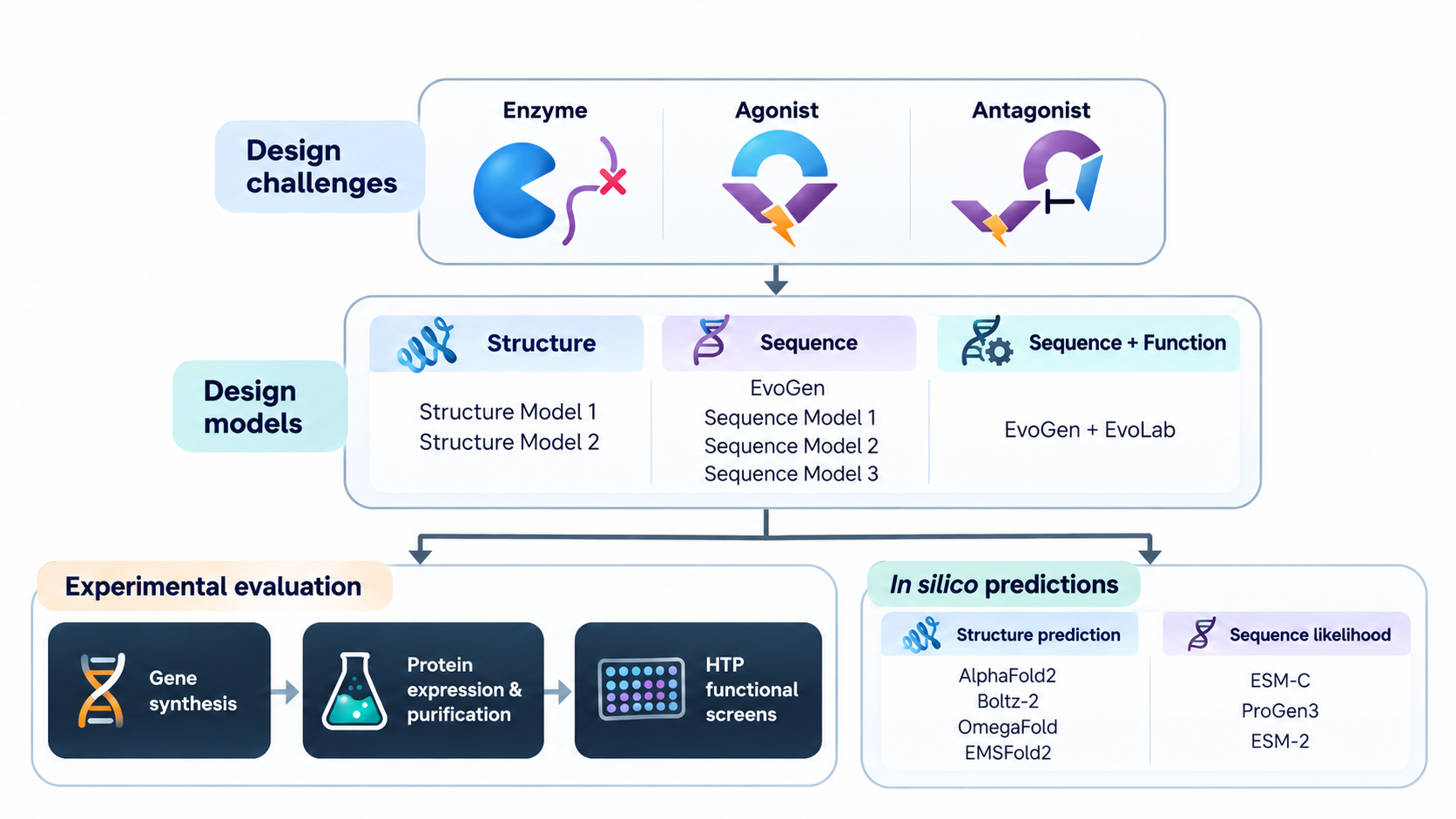
Evo TestBench benchmarks protein design models across enzyme, agonist, and antagonist challenges, evaluating generated sequences through experimental function and in-silico prediction.
We built TestBench for two practical reasons. First, when we start a new protein design campaign, we need to understand which models, or combination of models, are best suited to the problem. Second, we want to understand where current approaches succeed and fail to improve what we build next.
Our current TestBench models are asked to design proteins spanning three distinct functional challenges:
- Enzymes (protease) that catalyze reactions,
- Agonists that activate cytokine receptors, and
- Antagonists that bind cytokines and prevent receptor activation.
The resulting sequences are then built and experimentally tested for their intended function. This shows us whether a model can generate functional proteins, where different modeling approaches are strongest, and how those strengths map into different engineering problems.
No benchmark can test every function across every protein family, just as no one can validate every output of a language model. TestBench covers three design problems and measures specific functions, not every property a therapeutic protein needs to succeed in the clinic. A model that performs well here has not proven that it will consistently perform well on every problem. The goal is to understand what each model can do, where the evidence is strong, and where we still need to learn more.
Existing benchmarks focus on prediction tasks and binder design
There have been several major benchmarking efforts in the past decade operating at the intersection of deep learning and protein biophysics. The most famous, CASP, crowned AlphaFold the victor in protein folding, work for which its developers shared the 2024 Nobel Prize in Chemistry. ProteinGym maintains a large set of updated functionality prediction tasks. These have been crucial in advancing the field in protein understanding yet were not constructed to assess a protein design model’s capacity to produce novel, functional protein sequences.
More recently, companies have held protein design events, including Johnson & Johnson’s Quickfire Challenge for therapeutic antibody-design techniques. Adaptyv Bio had a series of binder-design competitions with results published on Proteinbase. While these report on the generative capacity of protein design models, they are limited in functional scope to antagonists – proteins that bind other proteins to inhibit a cellular pathway. Therapeutic proteins maintain a far greater span of function, from targeted degradation and small molecule synthesis to gene editing and pathway activation. We are unaware of a benchmark that characterizes the capability of models to tackle such challenges.
TestBench captures the trade-offs of protein design models
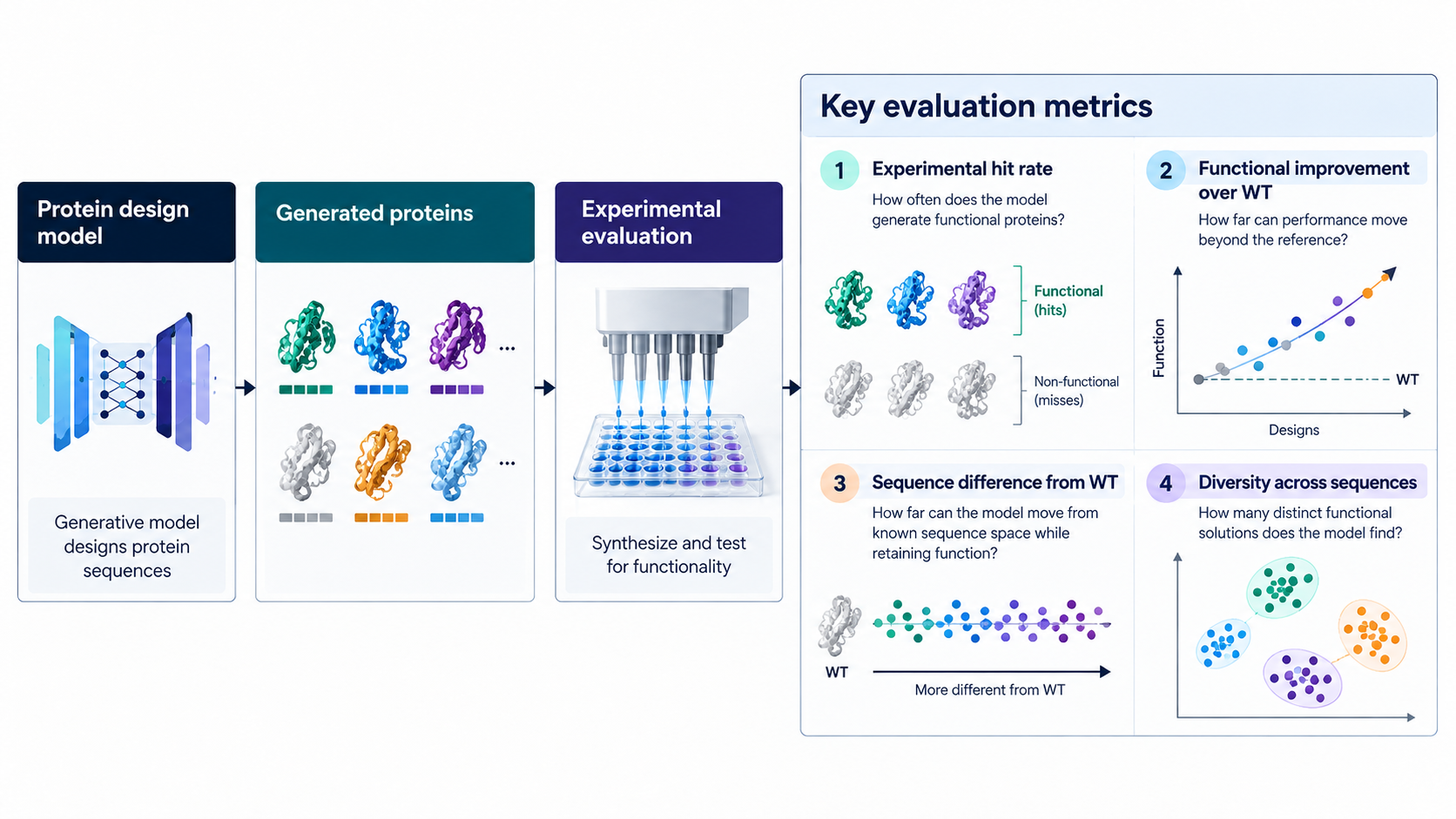
After the functional challenges, the second key component of TestBench is how we evaluate the models, which needs to capture both the breadth and depth of successful generations. A model can generate many active proteins that sit close to known sequences. Another model can explore farther from nature but lose function as it moves away. A third model can produce fewer hits, but may have properties that are especially valuable for downstream engineering. Our metrics are designed to capture the ways in which any of these models could be useful for therapeutic protein generation.
Evo TestBench benchmarks protein design models across enzyme, agonist, and antagonist challenges, evaluating generated sequences through experimental function and in-silico prediction.
TestBench evaluates protein models across the following key dimensions:
- Experimental hit rate: How many of the proteins we built performed the primary function we asked the model to design? A higher hit rate can make a design campaign considerably more experimentally efficient.
- Functional improvement over wild type: How do the active designs compare with the starting or reference protein? In many therapeutic programs, we also want to know whether that function can be meaningfully moved beyond the starting point.
- Novelty from the reference: How far can a model move through sequence space while retaining the intended function? Designs further from known sequences can provide new starting points for engineering properties that nature did not optimize for a therapeutic application.
- Diversity across sequences: Did the model find one solution repeatedly or several distinct solutions to the same functional problem? A diverse set of functional proteins gives us more options as we begin selecting for properties that were not part of the initial screen.
These measures can pull against each other. Moving farther from natural sequence space can make function harder to preserve. Maximizing hit rate can favor conservative designs. The purpose of TestBench is to make those trade-offs visible so that the best combination of models can be identified to provide the greatest chance of success in a therapeutic design initiative.
Why how we design proteins matters
Evozyne is founded on the premise that a tightly integrated design-build-test-learn cycle is the fastest, most consistent approach to produce transformative protein therapeutics. The lab is not simply where a model is validated at the end. It is where the system receives information that can change what it does next. The primary goal of TestBench is to evaluate the fundamental hypothesis that pushing the boundaries of natural proteins to produce therapeutics demands experimental data.
Our objective is to identify the correct suite of protein models for a given design challenge. We utilize several models simultaneously in our design-build phases. TestBench enables us to match the strengths of a given set of protein models with the requirements and technical hurdles presented by a specific challenge.
Let biology make the final call
Fast computational evaluations will remain essential for developing and refining protein design models. When the goal is to design proteins that alter biology, experimental function must remain the benchmark.
That principle is the foundation of Evo TestBench.